
Polar Bears, Glaciers and the Wild Heart of Svalbard
Twelve nights aboard a five-star expedition ship in the Arctic wilderness — where polar bears roam, glaciers calve and nature delivers surprise after surprise.
10 September 2026
Few corners of the planet can match the raw, uncompromising grandeur of the Svalbard Archipelago. Positioned just 600 miles from the North Pole and barely touched by human civilisation, these islands sit at the very edge of the navigable world — a place where nature operates entirely on its own terms.
Spitsbergen, the archipelago's largest island, is a landscape of soaring glacier-clad mountains, ink-dark fjords and tundra plains that bloom, improbably, with wildflowers in the brief Arctic summer. The light here has a particular quality too: lingering and luminous, stretching across endless horizons long after the rest of Europe has gone to sleep.
This 12-night expedition, operated in partnership with Hapag-Lloyd Cruises aboard the five-star Hanseatic Nature, spends eight full days probing the fjords and coastlines of Spitsbergen — following in the tracks of early explorers and seeking out the extraordinary wildlife that has made this archipelago legendary.
What makes this voyage distinctive
Expedition cruising demands flexibility, and this voyage offers it in abundance. Rather than following a fixed port-to-port timetable, the captain and expedition team shape each day's programme around conditions on the water — ice, weather and wildlife sightings all influence where the ship heads and when. The goal of circumnavigating Spitsbergen is always in sight, but the true reward lies in the improvised moments: a polar bear sighted from the bow, a glacier calving suddenly into a still fjord, a cliff face erupting with thousands of seabirds.
The voyage begins and ends with a specially chartered flight, taking passengers from Germany to Longyearbyen and returning via Tromsø — a thoughtfully constructed journey that keeps the focus firmly on the expedition itself.
A landscape on a heroic scale
Spitsbergen's scenery operates at a scale that takes some adjustment. In Hornsund, one of the island's most dramatic southern fjords, mighty glaciers pour down from mountain summits into icy inlets — a picture of frozen grandeur that feels almost absurdly cinematic. Further north, the Smeerenburgfjord is ringed by steep peaks, and the vast Monacobreen glacier in the Liefdefjord presents an extraordinary sight: a five-kilometre-wide wall of ice, constantly shedding blocks into the water below.
The glacier bears the name of Prince Albert I of Monaco, who explored this region in the early twentieth century — and standing before it today, it's easy to understand what drew him here. Whether viewed from the ship's deck or from a Zodiac on the water, the spectacle is genuinely humbling.
Wildlife in extraordinary abundance
Svalbard's wildlife is the headline act. Between 3,000 and 4,000 polar bears are thought to inhabit the region, and the expedition makes every effort to seek them out in their preferred habitat among the shifting ice floes of northeast Spitsbergen. Sightings are never guaranteed — that's the nature of a genuine wilderness — but the ship ventures as close to the ice as safely possible in the hope of watching these magnificent animals hunt.
Walrus colonies gather on flat coastal ledges at Torellneset, where bulls weighing over 1,000 kilograms bask in extraordinary numbers. Reindeer roam Barents Island freely, and the sea around the archipelago is frequented by whales that occasionally follow passing ships. The cliffs of Alkefjellet — the so-called bird mountain — are home to thousands of thick-billed murres, kittiwakes, glaucous gulls, Arctic terns and eider ducks, a cacophony of life on an otherwise silent coast.
History frozen in the ice
The human story of Spitsbergen is a haunting one. At Hornsund, among the oldest whaling sites in the archipelago, wooden boats, cabins and vast accumulations of whale bones remain where they were left, preserved by the Arctic cold in a kind of accidental monument to an industry long gone. Around 50 whaling stations were once registered across Spitsbergen — their remains scattered along the coastlines as silent reminders of a different era.
At the other end of the historical spectrum, Ny-Ålesund offers a glimpse of the archipelago's more recent past. This former mining settlement and airship base is now an international research station — among the world's most northerly inhabited communities — where Arctic terns nest beside the roads and Svalbard reindeer wander between the buildings.
Tundra walks and Zodiac landings
Zodiac excursions bring passengers ashore throughout the voyage, opening up experiences that no larger ship could offer. On Nordaustlandet — an island largely covered by ice caps — guided hikes across the sparse tundra reveal Svalbard poppies and purple saxifrage pushing through the ground with quiet determination. Ashore at various points along the route, the expedition team accompanies every landing, providing both safety and expert context for what passengers are seeing.
Why the ship suits this voyage
The Hanseatic Nature was purpose-built for exactly this kind of expedition. Launched in 2019 and carrying a maximum of 230 passengers, the ship holds a PC6 ice class rating, allowing it to navigate safely among Arctic pack ice. A dedicated bow walkway gives passengers unobstructed front-row views for wildlife and scenic moments, while the spacious open decks allow everyone a chance to observe without crowding.
Below deck, the HanseAtrium serves as the social and intellectual hub of the voyage — a well-designed space where the qualified naturalist expedition team delivers evening talks and briefings. With a crew of 175 serving fewer than 230 guests, the level of personal attention is notably high for an expedition vessel, combining the rigours of genuine wilderness travel with five-star comfort.
Who would enjoy this voyage?
This expedition rewards curious, adaptable travellers with a genuine appetite for wilderness. Those who relish the idea of a day shaped by wildlife sightings rather than a shore excursion schedule will feel entirely at home. A reasonable level of mobility is useful for Zodiac landings and tundra walks, though the ship itself is extremely comfortable for those who prefer to observe from deck. Nature lovers, wildlife photographers and anyone drawn to the high Arctic will find Svalbard an unforgettable destination.
For travellers who have explored more conventional cruise destinations and are ready for something that feels genuinely remote and adventurous, this is a compelling next step. Explore the voyage further on the CruiseQuest website to find out how to join Noble Caledonia aboard the Hanseatic Nature.

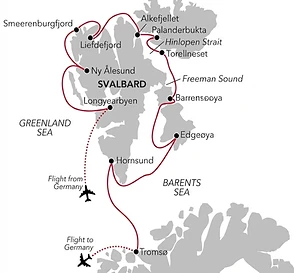
The voyage
In the Realm of the Polar Bear
Flights from London→Longyearbyen / Spitsbergen / Tromso→Return to London
Explore further
This article was created with the assistance of artificial intelligence using publicly available voyage information. While every effort is made to keep content accurate and up to date, some details may not be 100% correct — please always confirm specifics with a travel advisor before booking.