
Ancient Shores and Island Light: Cruising Italy's Archipelagos
From Maltese harbours to Tuscan ports, this intimate ten-night voyage threads together Sicily, Sardinia, Corsica and Elba aboard a private-yacht-style motor vessel.
2 September 2026
There is a particular pleasure in arriving somewhere by sea — the gradual reveal of a coastline, the smell of warm stone and salt air as a harbour draws near. On this ten-night voyage through the islands of Italy and beyond, that pleasure is multiplied again and again as the MS Monet glides between some of the Mediterranean's most storied shores.
The itinerary stretches from Valletta in Malta to the Tuscan port of Livorno, taking in Sicily, the Aeolian island of Lipari, Sardinia, French Corsica and finally Elba. Each island brings its own character — volcanic drama, Phoenician ruins, medieval alleyways, Baroque grandeur — and yet the journey feels coherent, unhurried and deeply rewarding.
This is not a voyage for those who prefer enormous resort ships and packed pools. It is for travellers who want to get closer: to the history, the landscapes and the local life that only a smaller vessel can access.
What makes this voyage distinctive
Where most Mediterranean cruises skim the surface of a region, this itinerary burrows into it. Rather than a single overnight in Naples or a half-day in Palermo, the route is shaped around islands — places that have preserved their own identities precisely because they sit at a slight remove from the mainland. From the ancient Greek theatres of Sicily to the Nuragic towers of Sardinia and Napoleon's island of exile off the Tuscan coast, the destinations are joined by threads of archaeology, geology and culture that reward a curious mind.
The inclusion of less-visited ports such as Oristano in Sardinia and Trapani's remarkable salt pans adds genuine depth. These are not the places that appear on standard itineraries, and they are all the more compelling for it.
Ancient ruins and 3,000 years of history
Sicily alone could sustain a week's exploration. Founded by the Greeks in 734 BC, Syracuse grew to rival Athens as a centre of power and beauty, and the Neapolis Archaeological Park still contains a Greek theatre with seats carved directly from limestone. Nearby, the extraordinary Ear of Dionysius — a vast grotto known for its resonant acoustics — sits in what was once a working quarry.
Sardinia layers its history with equal generosity. At Nora, founded by the Phoenicians and later expanded by Carthaginians and Romans, visitors can walk among baths decorated with splendid mosaics and the ruins of a theatre that was eventually swallowed by the sea in the third century AD. Further north, the ancient settlement of Tharros traces occupation from nuraghic times through Punic and Roman eras to the early Christian period — all in a single atmospheric site.
The Nuraghe Palmavera, approached via Porto Torres, adds another chapter: a Bronze Age complex whose main tower retains its original dome-shaped ceiling, dating to around 1100 BC. These are not reconstructions or museum pieces — they are open landscapes saturated with time.
Culture, faith and baroque grandeur
Not all the history here is ancient. The Baroque town of Noto, rebuilt after a devastating earthquake in 1703, unfolds along terraced streets lined with honey-coloured churches and palaces. Taormina, perched in the shadow of Mount Etna, has drawn travellers since the nineteenth century, its Greek theatre framing views of the coastline and the volcano in equal measure.
In Alghero, colonised by Catalans in the fourteenth century, the medieval streets and city walls carry a distinctly Iberian character — the town is still sometimes called Barceloneta, and the Catalan influence remains woven into the local language and architecture. And in Bastia, the former Genoese capital of Corsica, a walking tour reveals a layered historic quarter of chapels, Baroque oratories and tall, sunlit facades overlooking the harbour.
Landscape, salt and volcanic islands
Between Trapani and Marsala, a protected area of ancient salt pans stretches across the landscape in shifting tones of white and pink, worked by the Phoenicians and still producing salt today. A visit to the local museum and a nearby farmhouse — where Sicilian olive oils and wines can be tasted — brings this quietly spectacular place to life.
Lipari, largest of the Aeolian Islands, is reached by tender from the ship — an arrival that emphasises the intimacy of the voyage. A drive around the volcanic landscape, a walk through the hilltop fortress town and a visit to the archaeological museum make for a richly varied day on an island that rewards exploration at every turn.
Elba, the final island call before Livorno, is best known as Napoleon's place of exile, but its charms extend well beyond historical association to the kind of quietly beautiful Mediterranean scenery that lingers long in the memory.
Why the ship suits this voyage
At 220 feet and with a maximum of just 50 guests, the MS Monet operates on an entirely different scale from the floating hotels that dominate much of the cruise market. Originally built in 1970 and thoroughly refurbished in more recent years, she carries the atmosphere of a private motor yacht — warm, informal and entirely focused on the experience of being somewhere rather than the spectacle of the ship itself.
Her modest size means she can anchor off Lipari and use local tenders while larger vessels cannot, and it means that shore excursions feel like private arrangements rather than managed crowds. The style of travel is one of genuine discovery, and the ship is an enabler of that rather than a destination in itself.
Who would enjoy this voyage?
This is a voyage for independently minded travellers who bring genuine curiosity to a destination. Those with a love of classical history, Mediterranean archaeology or island culture will find the itinerary exceptionally well constructed. It suits those who prefer conversation to entertainment, exploration to sunbathing — though there is plenty of time at leisure at each port too.
Travellers who have done the mainstream Mediterranean and want to go deeper, or who are new to cruising and wary of large ships, will both find something very much to their taste here.
From the Phoenician salt pans of western Sicily to the medieval lanes of Alghero, this is a voyage that accumulates meaning as it goes — each island adding a new layer to a portrait of the Mediterranean that stays with you long after disembarkation. If it sounds like the journey you have been looking for, we would encourage you to explore it further.

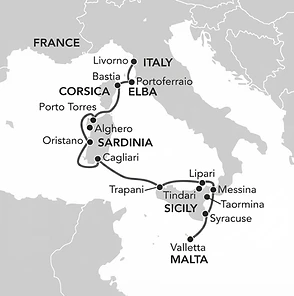
The voyage
Islands of Italy
Flights from London→Valletta / Syracuse / Taormina / Lipari / Trapani / Cagliari / Oristano/ Alghero / Bastia / Portoferraio / Livorno→Return to London
Explore further
This article was created with the assistance of artificial intelligence using publicly available voyage information. While every effort is made to keep content accurate and up to date, some details may not be 100% correct — please always confirm specifics with a travel advisor before booking.