
Dragons, Spice Islands and Coral Reefs: Indonesia by Small Ship
Sixteen nights exploring Indonesia's most remote islands — from Komodo dragons to the Spice Islands and Bunaken's coral reefs — aboard the intimate MS Island Sky.
5 November 2026
Indonesia is not so much a country as a world unto itself. Spread across more than seventeen thousand islands, it encompasses ancient trade routes, extraordinary wildlife, sacred landscapes and communities whose lives have changed little over centuries. To travel through it properly requires time, curiosity and, above all, a vessel small enough to reach the places the cruise ships cannot go.
This sixteen-night voyage aboard the MS Island Sky does precisely that. Beginning in Bali and ending in Singapore, the route threads through the Nusa Tenggara islands, the historic Maluku archipelago, the north coast of Sulawesi and the extraordinary waters of Bunaken National Park — with a call in the small nation of East Timor along the way. It is, in the truest sense, an expedition.
These are not destinations you will find on the usual tourist trail. Several of the islands visited are genuinely difficult to reach by any conventional means, and that inaccessibility is precisely what has preserved their character.
What makes this voyage distinctive
The itinerary is guided, in part, by conditions on the ground. The Captain and Expedition Leader adapt landing sites as the journey unfolds, which means the experience has an element of genuine discovery rather than a pre-packaged schedule. A fleet of purpose-built Zodiacs extends the ship's reach still further, allowing landings on beaches with no jetties, access to lagoons and coral reefs, and visits to communities seldom encountered by outside travellers. The small number of passengers on board ensures that when you do find yourself on a remote shoreline, it remains a remote shoreline.
Wildlife encounters in remarkable settings
For many travellers, the Komodo dragons will be the single most memorable sight of the voyage. Growing up to twelve feet in length and largely unknown to the western world until 1910, these formidable lizards are encountered in the wild, escorted by the island's wardens through the national park to the feeding station. Along the way there is a reasonable chance of spotting frigate birds, white buffalo and long-tailed monkeys.
In Sulawesi, the Tangkoko Nature Reserve protects 8,700 hectares of lowland rainforest on the slopes of Mount Tangkoko. This is one of the last refuges of the tarsier — the world's smallest primate, nocturnal and found nowhere else — alongside black macaques, maleo birds, cuscus and hornbills. Guided nature walks here, led by the ship's naturalist team, offer a patient and rewarding way into a forest that reveals itself slowly.
An underwater world of extraordinary richness
Bunaken National Park, situated near the heart of the Coral Triangle, contains close to 400 species of coral and over 90 species of fish, including bluestripe snapper and emperor angelfish. Seven of the eight known species of giant clam are found in these waters. The ship's Zodiacs ferry passengers to the beach, where snorkelling platforms are set up to allow proper exploration of the reef at a relaxed pace. It is the kind of snorkelling that reminds you why coral reefs once seemed inexhaustible in their variety.
History written in forts and spice plantations
The Maluku Islands — the original Spice Islands — carry the evidence of centuries of colonial competition in their architecture, their plantations and their ports. Portuguese, Dutch and English powers fought for control of the clove, nutmeg, mace and cinnamon trade from the fifteenth century onwards, and the Dutch East India Company eventually secured its monopoly. The fort ruins and colonial-era buildings that remain are a tangible record of that history.
Ambon, once the Dutch administrative centre for the region, also carries an unexpected scientific legacy: it was here, and across the surrounding islands, that Alfred Russel Wallace spent years observing wildlife and arrived, independently of Darwin, at a theory of natural selection. The voyage follows something of his footsteps through Halmahera, Tidore and Ternate, where local guides lead walks in the places Wallace himself explored.
The small island nation of East Timor, which gained independence from Indonesia only in 2002, adds another historical dimension — Portuguese colonial towns set against forested slopes and a landscape still teeming with wildlife.
Sacred landscapes and surreal scenery
The three crater lakes of Kelimutu National Park on Flores are among the most visually arresting sights in Southeast Asia. Each lake is a different colour — shifting over time between turquoise, green and deep red — and nobody has ever offered a fully satisfactory scientific explanation for the changes. Local people believe the souls of the dead rest in these waters, and the site carries a spiritual weight that outlasts any geological theory. On Satonda Island, an uninhabited wooded island with a fringing reef, a small crater lake is decorated with shells, coral and 'wishing' stones hung in the surrounding trees — a quieter, more intimate kind of wonder.
Why the ship suits this voyage
The MS Island Sky is a small, well-appointed expedition vessel — one of Noble Caledonia's two flagships — built in Italy and designed for exactly this kind of journey. Its size allows access to anchorages and landing sites that larger ships cannot reach, while the on-board lecture programme makes the time at sea genuinely informative. The expedition team, naturalists and local guides form an integral part of the experience, providing context that turns a beautiful journey into an educational one.
Who would enjoy this voyage?
This voyage suits independently minded travellers with a genuine interest in natural history, culture and history rather than resort comforts. It appeals to those who want to snorkel in a national park rather than a hotel pool, who find a colonial fort more interesting than a duty-free shop and who understand that the best experiences often require a little patience and an early start. Some physical agility is useful for Zodiac landings, but the pace is thoughtful rather than demanding.
From Komodo's ancient lizards to the Wallace-haunted forests of the Spice Islands, this is Indonesia at its most authentic — and most unforgettable. Explore the full voyage details to find out more.

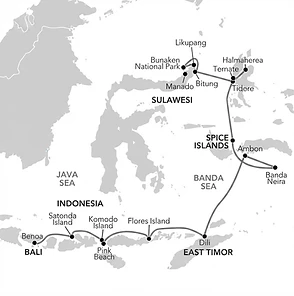
The voyage
Indonesian Island Odyssey
Flights from London→Bali / Nusa Tenggara Islands / East Timor / Maluku Islands / Sulawesi / Bunaken National Park / Likupang / Singapore→Return to London
Explore further
This article was created with the assistance of artificial intelligence using publicly available voyage information. While every effort is made to keep content accurate and up to date, some details may not be 100% correct — please always confirm specifics with a travel advisor before booking.