
Along Four Rivers: Germany's Most Scenic Waterways by Small Ship
From the Saar to the Neckar, this seven-night river voyage through Germany weaves together Roman history, medieval towns, vine-clad valleys and Baroque palaces.
13 October 2026
There is something quietly revelatory about travelling through a country by river. Roads and railways pass through landscapes; rivers are woven into them. On this seven-night voyage aboard the MS Thurgau Saxonia, guests trace the Saar, Moselle, Rhine and Neckar in sequence — four distinct waterways, four distinct characters, and centuries of German history unfolding gently at the water's edge.
This is a journey through the heart of a country that rarely gets the credit it deserves as a travel destination. Ancient Roman cities, half-timbered medieval market squares, vine-terraced hillsides and one of Europe's grandest Baroque palaces all feature along the route, which runs between Saarbrücken in the west and Stuttgart in the south-east.
Timed for late summer, the voyage catches Germany at its most appealing — warm days, long evenings, and the popular towns still pleasantly unhurried.
What makes this voyage distinctive
Few river itineraries manage to incorporate four separate rivers in a single week, and fewer still move in such a logical, unhurried arc. Rather than looping back or repeating stretches, this route flows naturally from one waterway to the next, each with its own mood and scenery. The result feels less like a tick-list of ports and more like a sustained immersion in a particular region of Europe — one that most visitors never see in this kind of depth.
Noble Caledonia has planned the voyage for those who prefer experience over logistics. Guided excursions are woven into the schedule at the most rewarding stops, while the ship's central overnight moorings in several towns allow guests to step ashore independently after dinner at their own pace.
Roman history and ancient cities
The voyage's most historically significant stop comes early, when the ship arrives in Trier — the oldest city in Germany and, remarkably, once the capital of the Roman Western Empire. The sheer concentration of Roman monuments here is extraordinary for anywhere north of the Alps. The Porta Nigra, a vast and largely intact Roman city gate, dominates the townscape and remains one of the most impressive ancient structures in northern Europe. A guided tour brings the city's layered history into sharp focus.
Further along the Neckar River, Bad Wimpfen offers a very different but equally absorbing slice of history. This compact medieval town is dominated by the remains of the largest Hohenstaufen Imperial palace north of the Alps, its towers rising dramatically above the roofline. Walking its streets — lined with half-timbered houses in both Alemannic and Franconian styles — is to move through a remarkably well-preserved record of pre-historic, Roman and medieval occupation.
Scenic waterways and legendary landscapes
Each river brings its own visual rewards. The Moselle, first cultivated by the Romans, winds through a valley of steeply terraced vineyards, its banks lined with handsome villages that seem to have changed little over centuries. The Rhine, joined later in the journey, deals in grander drama: the Rhine Gorge, hilltop castles emerging from the treeline, and the legendary Lorelei Rock all make their appearance as the ship moves through some of the most iconic river scenery in Europe.
The Neckar, by contrast, is quieter and more intimate — a river of small villages, wooded hillsides and romantic castle ruins at Neckarsteinach and Hirschhorn. It is exactly the kind of scenery that rewards an afternoon spent simply watching the world drift by from the sun deck.
Wine, markets and medieval squares
Bernkastel, on the Moselle, is the kind of town that earns its reputation. The medieval market square, surrounded by intricately decorated half-timbered houses, is one of the most attractive in Germany. The morning walking tour here culminates in a tasting of the region's wines — the Moselle valley produces some of Germany's finest whites, and sampling them in situ, with the vineyards visible on the hillsides above, is a particular pleasure.
Heidelberg and Ludwigsburg: two unmissable highlights
Heidelberg needs little introduction, but seeing it from the river and then on foot, with a knowledgeable guide, adds genuine depth to a familiar name. Germany's oldest university city — its institution founded in 1386 — is home to a dramatically positioned castle, a handsome old town and a romantic atmosphere that has inspired writers and artists for centuries. The afternoon tour covers the castle, the historic centre and the city gates.
At the other end of the aesthetic spectrum, Ludwigsburg Palace is a revelation. Built in the early 18th century for Duke Ludwig Eberhard of Württemberg, this is one of the largest surviving German Baroque palaces — a

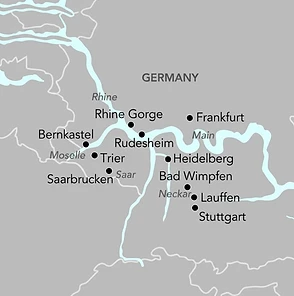
The voyage
Four Rivers of Germany
Flights from London→Saarbrucken / Trier / Bernkastel / Rudesheim / Heidelberg / Bad Wimpfen / Lauffen / Ludwigsburg Palace / Stuttgart→Return to London
Explore further
This article was created with the assistance of artificial intelligence using publicly available voyage information. While every effort is made to keep content accurate and up to date, some details may not be 100% correct — please always confirm specifics with a travel advisor before booking.