
From Volcanic Islands to Ancient Medinas: An Atlantic Coast Voyage
Sail from the remote Cape Verde archipelago through the Western Sahara to Morocco's storied Atlantic coast aboard the intimate MS Hebridean Sky.
28 October 2026
There are ocean voyages that connect the dots between familiar destinations, and then there are journeys that feel genuinely exploratory — routes that most travellers will never take, calling at ports rarely seen from the deck of a cruise ship. This 14-night Atlantic coast passage, from the scattered volcanic islands of Cape Verde to the imperial grandeur of Casablanca, belongs firmly in the second category.
The route threads together three distinct worlds: the Afro-Portuguese island culture of Cape Verde, the vast and little-visited shores of the Western Sahara, and the layered, ancient cities of Morocco's Atlantic seaboard. Between them, two days at sea offer the pleasures of unhurried passage — a lecture in the lounge, a book in the library, a quiet hour watching the ocean go by.
This is not a voyage of grand resort ports or well-worn itineraries. It is, instead, a journey along one of the Atlantic's most storied and overlooked coastlines, aboard one of the finest small ships afloat.
What makes this voyage distinctive
Few cruise itineraries venture into Western Sahara at all, let alone combine it with Cape Verde and Morocco in a single coherent arc. The route follows maritime trade winds that sailors have exploited for centuries, touching on islands that served as staging posts for explorers, ports that grew rich on salt and fish, and desert cities that most travellers have simply never considered visiting. The result is a journey with genuine rarity value — and a narrative thread that holds together beautifully.
The Cape Verde Islands: Africa, Portugal and the Atlantic
Cape Verde rewards those willing to look beyond the beach resorts. On Sal, the old salt pans at Pedra de Lume offer a peculiar and memorable experience — the salt extraction pools are dense enough to float in, and the industrial heritage of the island's nineteenth-century trade sits quietly in the landscape. Santiago, the largest island, carries a weightier history: Cidade Velha, founded by the Portuguese in 1462, is a UNESCO World Heritage Site and the oldest European colonial settlement in sub-Saharan Africa, its fort and cathedral rising above cobbled lanes that once witnessed the slave trade.
The greener, more mountainous islands offer a different kind of drama. Santo Antão's valley of Paul is among the most fertile corners of the archipelago, where sugar cane grows in the shadow of volcanic ridges and the national spirit, Grogue, is distilled by traditional methods at one of the island's oldest producers. São Nicolau, meanwhile, is quietly proud of its cultural heritage — Ribeira Brava was the intellectual heartland of Cape Verde in the nineteenth century, and that sense of considered, unhurried life persists.
Music, Culture and Island Life
Mindelo, on São Vicente, is widely regarded as the cultural capital of the archipelago, and an afternoon here makes it easy to understand why. Colonial architecture frames a lively harbour town full of cafés, music spilling from open doors and a market culture that feels entirely its own. An evening performance of local music and capoeira on board caps the experience perfectly, giving a sense of the living tradition that connects these islands to West Africa and Portugal in equal measure.
The Western Sahara: Off the Beaten Track
Leaving the islands, the voyage crosses to the African mainland and one of the most unusual stops on any cruise itinerary. Dakhla occupies a long peninsula jutting into the Atlantic, its white-washed buildings surrounded by sweeping sand dunes — an image of extraordinary remoteness. From the port of El Marsa, the journey continues to Laayoune, the principal city of Western Sahara, where Spanish-Saharan architecture, a camel market and traditional craft workshops offer a glimpse of a territory that almost no tourists ever see. It is, by any measure, a privilege.
Lanzarote and the Landscape of Fire
The Canary Islands provide a dramatic interlude before Morocco. Lanzarote's volcanic landscape — petrified lava fields, black sand beaches, vineyards planted inside volcanic craters — is unlike anywhere else in Europe. The island's great artistic legacy, shaped by César Manrique, is visible in extraordinary places: the natural auditorium of Los Jameos del Agua, carved inside a volcanic tunnel, and the Mirador del Río, a viewpoint of breathtaking elegance set into the cliffs above the Chinijo Archipelago.
Morocco: Kasbahs, Souks and Atlantic Cities
Morocco's Atlantic coast is less visited than Marrakech or Fez, but no less rewarding. Agadir, largely rebuilt after a devastating earthquake in 1960, still possesses its hilltop Kasbah Oufella, reached by cable car and offering panoramic views across the bay. Essaouira — one of the Atlantic coast's most beguiling towns — combines a fortified medina with a strong artistic and musical heritage. And Casablanca, the final port, provides a fitting conclusion: a city of modernist ambition and layered history, looking out over the same ocean the voyage has been crossing for two weeks.
Why the Hebridean Sky suits this voyage
The MS Hebridean Sky is an all-suite small ship, purpose-built for itineraries that reward intimacy and flexibility over scale. With a compact passenger complement, she is able to call at smaller ports and offer a more personal experience of every destination. The ship carries a Noble Caledonia onboard team including a guest speaker, ensuring that the history and culture encountered ashore is given proper context. There is no sense of processing passengers through a port — this is travel at the pace of curiosity.
Who would enjoy this voyage?
This voyage suits curious, independently minded travellers who have already explored Europe's more familiar corners and are looking for something genuinely different. An interest in history, culture and landscape will be richly rewarded. Those drawn to African and Atlantic history, colonial heritage and the texture of lesser-visited cities will find it particularly compelling. It is not an adventure in the physical sense, but it is absolutely an adventure of the mind.
From the salt pans of Sal to the souks of Casablanca, this is a journey that lingers long after the ship has docked — explore the voyage in full to discover what awaits.

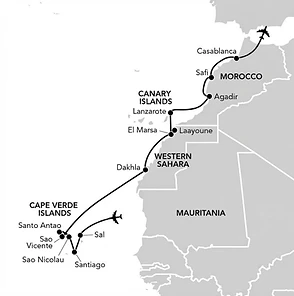
The voyage
Cape Verde to Casablanca
Flights from London→Sal / Palmeira / Praia / Tarrafal / Porto Novo / Mindelo / Dahkla / El Marsa / Arrecife / Agadir/ Essaouira / Casablanca→Return to London
Explore further
This article was created with the assistance of artificial intelligence using publicly available voyage information. While every effort is made to keep content accurate and up to date, some details may not be 100% correct — please always confirm specifics with a travel advisor before booking.